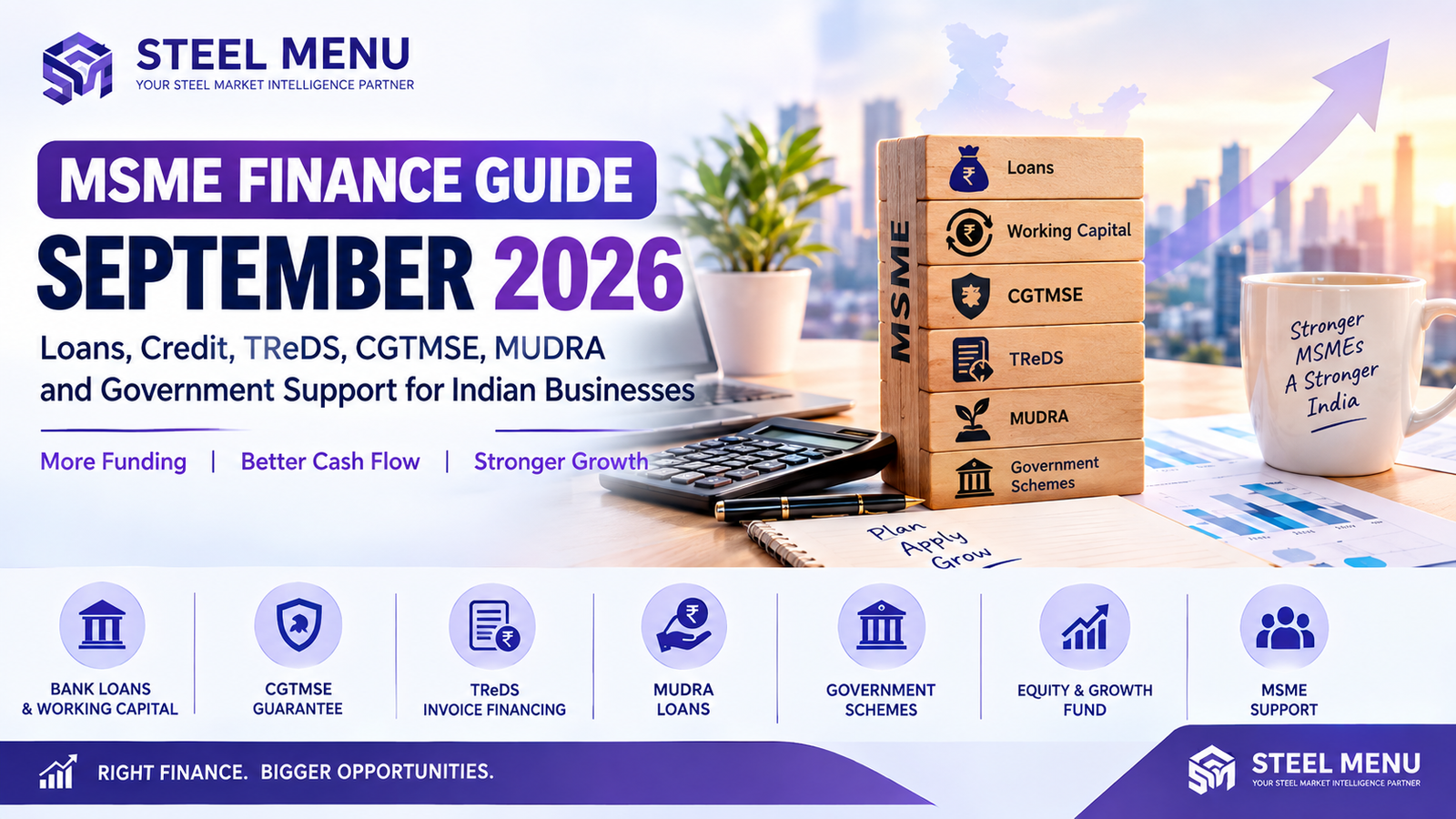
MSME Finance Guide September 2026
Loans, working capital, CGTMSE, TReDS, MUDRA, government support, delayed-payment solutions and practical financial planning for Indian MSMEs in September 2026.
For Indian MSMEs, September 2026 is not just about arranging a loan when cash becomes tight. The financing environment is increasingly built around formal registration, digital credit assessment, invoice financing, credit guarantees, working-capital discipline and equity support.
The latest Ministry of MSME dashboard showed 9.65 crore enterprises registered through Udyam and Udyam Assist combined as of 23 September 2026, including about 5.38 crore Udyam registrations and 4.28 crore Udyam Assist registrations.
The same dashboard reports more than 42.71 crore employment generated within its registration framework. These figures include informal micro enterprises registered through Udyam Assist and therefore should not be treated as a direct measure of the entire economically active MSME population.
The Economic Survey 2025-26 reported that MSMEs accounted for approximately 31.1% of GDP, 35.4% of manufacturing and 48.58% of exports. The scale of the sector explains why access to finance has become a central policy focus.
1. First finance step: make the business formally bankable
An MSME seeking finance in September 2026 should first ensure that its formal business information is consistent across government and financial records.
The Udyam Registration portal currently classifies enterprises using investment and turnover limits introduced from 1 April 2025.
| Category | Investment Limit | Turnover Limit |
|---|---|---|
| Micro | Up to ₹2.5 crore | Up to ₹10 crore |
| Small | Up to ₹25 crore | Up to ₹100 crore |
| Medium | Up to ₹125 crore | Up to ₹500 crore |
Udyam Registration is free and paperless, and the government portal states that PAN and GST-linked information is drawn from government databases where applicable.
For finance purposes, this formalisation matters because the enterprise's registration, GST filings, bank transactions, tax records, receivables and financial statements can collectively support credit assessment.
2. Understand the difference between working capital and term finance
One of the common financing mistakes is using the wrong type of loan for the business requirement.
Working-capital finance is generally used for recurring operating requirements such as purchasing raw materials, maintaining inventory, paying suppliers and managing receivables.
Term finance is generally used for longer-life investments such as machinery, plant expansion, equipment, factory improvements or technology upgrades.
For a steel trader, for example, purchasing inventory for a three-month trading cycle is fundamentally different from financing a new warehouse, processing line or cutting machine.
The financing structure should therefore broadly match the economic life of the asset or business requirement.
3. The collateral-free credit environment has expanded
A significant 2026 finance development is the increase in the collateral-free lending limit for micro and small enterprises.
The government reported that the collateral-free lending limit for micro and small enterprises was increased from ₹10 lakh to ₹20 lakh with effect from 1 April 2026.
The same government briefing reported outstanding MSME lending of more than ₹36.7 lakh crore at that point, with quarterly growth of 23.5%.

4. CGTMSE can help MSEs access larger credit
The Credit Guarantee Fund Trust for Micro and Small Enterprises, commonly known as CGTMSE, is one of the important finance mechanisms available to eligible micro and small enterprises.
CGTMSE currently covers eligible fund-based and non-fund-based credit facilities of up to ₹10 crore per borrower, subject to the applicable scheme conditions.
Depending on borrower category and scheme conditions, guarantee coverage can generally range from 75% to 90%. Women entrepreneurs can receive enhanced coverage of up to 90% under specified conditions.
| CGTMSE Feature | Latest Position |
|---|---|
| Maximum eligible credit facility | Up to ₹10 crore per borrower |
| Typical guarantee coverage | Generally 75% to 90%, subject to conditions |
| Women entrepreneurs | Up to 90% in specified cases |
| Reported guarantees | Approx. 1.49 crore |
| Reported guarantee value | Approx. ₹15.12 lakh crore |
CGTMSE does not directly provide a loan to the MSME. It provides a guarantee mechanism to eligible lending institutions for qualifying credit facilities.
The enterprise must still approach a participating lender and satisfy its credit assessment requirements.
5. MUDRA remains relevant for smaller micro businesses
For smaller income-generating businesses, the Pradhan Mantri MUDRA Yojana, or PMMY, remains an important institutional credit route.
| MUDRA Category | Loan Amount |
|---|---|
| Shishu | Up to ₹50,000 |
| Kishor | Above ₹50,000 to ₹5 lakh |
| Tarun | Above ₹5 lakh to ₹10 lakh |
| Tarun Plus | Above ₹10 lakh to ₹20 lakh |
Tarun Plus is available to entrepreneurs who have previously taken and successfully repaid a Tarun-category loan, subject to applicable scheme requirements.
PMMY covers eligible manufacturing, trading and service activities, and both term-loan and working-capital requirements can be financed.
6. TReDS is becoming increasingly important for MSME cash flow
For manufacturing and supply businesses, the biggest financing problem is often not lack of sales. It is the gap between raising an invoice and receiving payment.
This is where the Trade Receivables Discounting System, or TReDS, becomes important.
TReDS is an electronic platform for financing eligible trade receivables of MSMEs from buyers such as large corporates. Financing institutions can finance eligible receivables, allowing MSMEs to improve liquidity without waiting for the customer's full payment period to expire.
The Union Budget 2026-27 stated that more than ₹7 lakh crore had already been made available to MSMEs through TReDS.
Budget measures also proposed greater use of TReDS for CPSE purchases from MSMEs, CGTMSE-backed support for invoice discounting, GeM-TReDS integration and the introduction of TReDS receivables as asset-backed securities.

7. Delayed payments can directly affect MSME finances
Cash-flow management should be treated as a finance function, not merely an accounting function.
Under Section 15 of the MSMED Act, where a written payment agreement exists, the agreed period cannot exceed 45 days. Where there is no written agreement, payment is generally required within 15 days.
Section 43B(h) of the Income-tax Act provides that certain sums payable to micro and small enterprises beyond the prescribed Section 15 period are deductible only on actual payment.
For an MSME supplier, proper Udyam status, invoice records, acceptance evidence and payment documentation therefore become important.
For a corporate buyer, delayed payments can have tax consequences in addition to the interest provisions under the MSMED Act.
TReDS and the MSME Samadhaan mechanism are among the formal tools available for addressing receivable and delayed-payment issues.
8. The 2026 Budget adds an equity route for growing SMEs
Debt is not the only form of business finance.
The Union Budget 2026-27 announced a dedicated ₹10,000 crore SME Growth Fund aimed at supporting future high-potential SMEs.
The Budget also announced an additional ₹2,000 crore allocation to the Self-Reliant India Fund to continue risk-capital support for micro enterprises.
The SRI Fund operates through a Fund-of-Funds model rather than functioning like a normal MSME bank loan.
9. PMEGP is relevant for eligible new micro enterprises
The Prime Minister's Employment Generation Programme, or PMEGP, supports eligible new micro enterprises in the non-farm sector through bank finance combined with eligible margin-money subsidy.
Ministry dashboard data for FY2021-22 through FY2026-27, as of 31 August 2026, showed:
| PMEGP Indicator | Cumulative Figure |
|---|---|
| Projects with bank loans sanctioned | 5,88,511 |
| Loan sanctions | Approx. ₹60,920.11 crore |
| Margin-money subsidy | Approx. ₹13,957.72 crore |
| Estimated employment generated | Approx. 38.34 lakh |
These figures are cumulative scheme statistics and do not mean that every existing MSME is eligible for fresh PMEGP support. Entrepreneurs should verify the current eligibility criteria before applying.
10. PSB Loans in 59 Minutes remains a digital credit channel
The government's PSB Loans in 59 Minutes platform provides another digital route for eligible borrowers.
According to the Department of Financial Services status report as of 7 June 2026, the platform had the following cumulative sanction data:
| Category | Loans Sanctioned | Amount |
|---|---|---|
| MSME | 21,51,850 | ₹4,13,540 crore |
| MUDRA | 5,96,080 | ₹16,690 crore |
| Retail | 19,17,230 | ₹43,450 crore |
| Total | 46,65,160 | ₹4,73,680 crore |
These are platform-level cumulative sanction figures and should not be confused with guaranteed approvals for an individual applicant.
11. What an MSME should prepare before applying for finance
A strong loan application is more than a collection of documents. It should present a consistent financial picture of the business.
Before approaching a lender in September 2026, an MSME should generally have its Udyam certificate, PAN, GST records where applicable, bank statements, income-tax returns, financial statements, debtor and creditor ageing, inventory details, existing borrowing information and projected cash flow organised.
For a manufacturing unit, lenders may also need information around machinery, production capacity, raw-material cycles and the order book.
For a steel trader, inventory turnover, debtor ageing, supplier credit period and steel-price volatility can be particularly important.
A business can show strong sales while still facing liquidity pressure if receivables and inventory are growing faster than cash generation.
12. September 2026 MSME finance checklist
- Registration: Ensure Udyam details are accurate and updated.
- Banking: Maintain clean account conduct and regular repayment history.
- GST: Check that GST records and reported turnover are consistent.
- Tax: Keep income-tax filings and financial statements current.
- Receivables: Track ageing, overdue invoices and customer concentration.
- Inventory: Compare stock levels with actual business requirements.
- Working capital: Match the credit limit with the operating cycle.
- CGTMSE: Check eligibility through the lending institution.
- TReDS: Evaluate invoice-financing opportunities where applicable.
- Government schemes: Confirm actual scheme eligibility before relying on a subsidy or guarantee.
- Total debt cost: Compare repayment burden rather than looking only at headline interest rates.
- Cash flow: Stress-test repayment ability against delayed collections or lower sales.

13. How MSMEs can improve finance readiness
Finance readiness is not created at the moment a business applies for a loan. It is built over time through disciplined business records, transparent transactions and predictable cash flows.
An MSME should ideally maintain a monthly financial dashboard covering sales, gross margin, inventory days, receivable days, payable days, cash balance, outstanding borrowing and interest expense.
Monitoring these numbers can make it easier to identify whether the business actually needs more working capital or whether the underlying issue is slow collections, excessive inventory or weak margins.
Conclusion
The MSME finance environment in September 2026 is becoming more diversified. Traditional bank loans remain important, but businesses can also consider working-capital facilities, CGTMSE-backed credit, MUDRA, TReDS invoice financing, PMEGP for eligible new micro enterprises and equity-oriented mechanisms such as the SRI Fund and the newly announced SME Growth Fund.
The biggest practical shift is that formal financial data is becoming increasingly important to credit access. Udyam registration, GST information, banking history, receivables, inventory and cash-flow visibility all contribute to how an enterprise presents itself to lenders and financing platforms.
For an MSME, the key question in September should therefore not simply be:
Instead, the business should ask:
This approach can help manufacturers, traders, service businesses and suppliers use debt and receivable finance more deliberately while avoiding unnecessary pressure on working capital.